
Play Chicken road 2 Now!
Home → Strategy
Chicken Road 2 Strategy
Approaching Chicken Road 2 sensibly
InOut Games released Chicken Road 2 in 2025 as a distinct crash mechanic rather than a traditional reel-based slot, establishing a unique market position. The theoretical return to player stands at 95.50%, meaning the house retains a 4.50% edge over infinite play cycles for all participants. This mathematical reality requires players to accept variance without expecting short-term profitability or guaranteed recovery of initial stakes during active sessions.
The maximum win potential reaches x3,608,855 across four difficulty tiers, offering extreme volatility that contrasts sharply with stable crash games like Chicken Road. That predecessor title shares the identical max win cap but operates with a significantly higher RTP of 98.00%, providing better long-term value retention. Players choosing Chicken Road 2 must weigh this lower return percentage against the specific lane structures available in each difficulty setting.
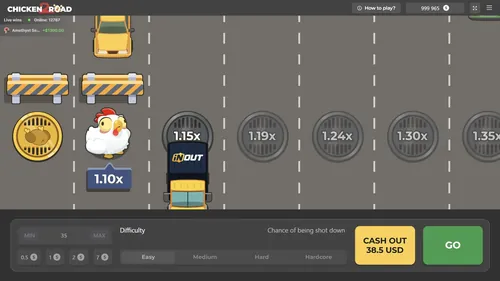
Bankroll rules that hold up
A defined bankroll separates disciplined players from those who chase losses in high-variance environments like Chicken Road 2 where rounds end abruptly. The game allows stakes from $0.01 to $200 per round, enabling micro-betting strategies that extend session longevity significantly compared to higher-limit alternatives. Maintaining a fixed budget prevents emotional decisions when the rising multiplier suddenly crashes before a successful cash-out occurs.
Bet sizing against volatility
Medium volatility in Chicken Road 2 demands bet sizing that accounts for the x3,608,855 maximum win ceiling without depleting funds quickly. Flat betting maintains consistency, whereas progressive staking raises stakes after losses and only accelerates the time to ruin despite the medium risk profile. Players should calculate their total exposure against the 95.50% RTP to ensure their bankroll survives the inevitable losing streaks inherent in crash mechanics.
Session limits worth setting
Setting strict time and loss limits protects players from the addictive nature of Chicken Road 2's rapid-fire round structure and instant results. Unlike slots with spinning reels, this InOut Games title offers immediate feedback on every decision, making uncontrolled play particularly dangerous for impulse users. Defining a stop-loss amount ensures that even hitting the hard mode lanes does not lead to financial distress beyond the planned entertainment budget.
Why chasing losses fails
Chasing losses in Chicken Road 2 ignores the immutable 4.50% house edge built into the 95.50% RTP calculation by InOut Games. Increasing bets after a crash does not alter the underlying probability of the chicken being hit on any given lane or step. Rational analysis shows that no betting system can overcome the statistical advantage held by the operator, regardless of how many rounds are played consecutively.
Chicken Road 2: key facts
| Parameter | Value |
|---|---|
| Game | Chicken Road 2 |
| Studio | InOut Games |
| Released | 2025 |
| RTP | 95.50% |
| House edge | 4.50% |
| Volatility | medium |
| Max win | x3,608,855 |
| Bet range | $0.01 – $200 |
Common systems and their limits
InOut Games releases Chicken Road 2 as a step-based crash game where the player must cash out before the chicken is hit, establishing a medium volatility environment for mobile play. This structure means that traditional slot mechanics like reels or paylines are entirely absent from the experience, forcing players to rely on timing rather than symbol combinations for any potential return. The theoretical return is set at 95.50%, which creates a house edge of 4.50% over a very long run, limiting the effectiveness of any betting system applied to this specific mechanic.
The maximum win cap stands at x3,608,855 in the Hardcore difficulty level, which features only eighteen lanes and requires precise timing to achieve such a high multiplier during a single rising round. This extreme ceiling contrasts sharply with Fish Road, another InOut Games title that offers a lower max win of x2,542,251.93 despite having a slightly better RTP of 96.00%. Players must recognize that chasing these top-tier multipliers involves significant risk due to the medium volatility inherent in the game's design and the instant nature of the crash mechanism.
Auto mode functionality allows players to set predefined cash-out points, yet it cannot override the mathematical reality that each round is an independent event with no memory of previous outcomes. The bet range spans from $0.01 to $200, providing flexibility for different bankroll sizes while maintaining the same underlying probability distribution across all difficulty levels. Understanding these limits helps players manage expectations, as no strategy can alter the built-in house edge or guarantee a profit in the short term.
Flat betting explained
Flat betting involves wagering the exact same stake every round, such as consistently betting $1.00 regardless of whether the previous outcome was a win or a loss, which simplifies bankroll management significantly. This approach aligns well with the medium volatility of Chicken Road 2, allowing players to endure the natural variance of the game without exposing themselves to rapid depletion of funds. By maintaining a constant bet size, players can calculate their expected loss based on the 4.50% house edge over a larger number of rounds, providing a more predictable gaming session.
The provably fair technology used by InOut Games ensures that each round's outcome is determined by a verifiable algorithm, meaning that flat betting does not influence the result but rather controls the rate of exposure to the house edge. Unlike progressive strategies that increase stakes after losses, flat betting keeps the financial risk per round constant, which is crucial for players who wish to extend their playing time on mobile devices. This method is particularly effective when combined with the auto mode feature, allowing for hands-free execution of a consistent staking plan.
Over a large sample size, the law of large numbers suggests that the actual return will converge toward the theoretical RTP of 95.50%, making flat betting a statistically sound method for long-term play. However, players should note that short-term results can vary widely due to the game's medium volatility, and a streak of losses can still deplete a bankroll if the bet size is too high relative to total funds. Setting a strict budget and adhering to it is essential, as the game offers no mechanisms to recover losses through altered betting patterns.
Progressive staking risks
Progressive staking involves raising the stake after a loss, a strategy that does not change the built-in house edge of 4.50% but instead accelerates the rate at which a player's bankroll is depleted. In Chicken Road 2, where the maximum win is x3,608,855 on the Hardcore level, attempting to recoup losses through increased bets can lead to catastrophic financial outcomes due to the game's medium volatility and instant resolution. This approach fundamentally misunderstands the independence of each round, as the probability of winning remains unchanged regardless of previous outcomes or bet sizes.
Fish Road, also developed by InOut Games, shares similar structural elements but has a lower max win of x2,542,251.93 and an RTP of 96.00%, yet progressive staking remains equally risky in both titles. The bet range of up to $200 in Chicken Road 2 allows for substantial wagers, but increasing these stakes after losses exposes players to the full force of the house edge much faster than flat betting. Mathematically, no staking system can overcome the negative expectation created by the 4.50% house edge, making progressive strategies a dangerous illusion of control.
The auto mode feature in Chicken Road 2 may tempt players to set aggressive cash-out targets, but combining this with progressive staking amplifies the risk of ruin during volatile periods. Since the game is a crash mechanic with no reels or spins, each round is a binary outcome of cashing out before the crash or losing the entire stake, leaving no room for gradual recovery. Players must recognize that raising stakes after losses only shortens the time to bankruptcy, as the expected value of each bet remains negative regardless of the amount wagered.
What the maths actually allows
The theoretical return to player (RTP) of 95.50% in Chicken Road 2 indicates that for every $100 wagered over a very long run, the game returns $95.50 to players on average, leaving a 4.50% house edge. This figure is a statistical average over hundreds of thousands of rounds and should never be interpreted as a forecast for any single session or even a week of play. Mobile players engaging with the Easy or Medium difficulty levels will experience a different variance profile compared to those attempting the Hardcore level, but the underlying mathematical expectation remains constant across all modes.
In comparison, Fish Road offers a slightly higher RTP of 96.00%, which translates to a smaller house edge of 4.00%, making it mathematically more favorable for players seeking better long-term returns. However, Chicken Road 2 compensates with a higher maximum win potential of x3,608,855 on the Hardcore level, appealing to players willing to accept a lower RTP for the chance of a larger payout. The medium volatility setting ensures that wins and losses are distributed relatively evenly, preventing extreme swings that are common in high-volatility games while still offering substantial reward opportunities.
Understanding the distinction between RTP and volatility is crucial, as a 95.50% RTP does not guarantee a specific return in the short term due to the random nature of the crash mechanic. The provably fair system ensures transparency, but it does not alter the mathematical reality that the house always retains an edge over time. Players should focus on managing their bankroll effectively within the $0.01 to $200 bet range, recognizing that no amount of analysis can change the fundamental odds embedded in the game's design.
Reading variance honestly
Variance in Chicken Road 2 refers to the fluctuation of results around the expected mean, driven by the medium volatility setting and the distinct difficulty levels available to players. The Hardcore level, with its eighteen lanes and potential for a x3,608,855 win, exhibits higher variance compared to the Easy level, which offers thirty lanes and a lower maximum multiplier of x23.24. Players must accept that periods of losses are inevitable and that the medium volatility ensures these swings are neither too frequent nor too extreme, providing a balanced gameplay experience on mobile devices.
Unlike Fish Road, which has a max win of x2,542,251.93 and an RTP of 96.00%, Chicken Road 2's variance is tied directly to the chosen difficulty level, allowing players to adjust their risk exposure. The 4.50% house edge remains constant regardless of the level selected, meaning that while the frequency and size of payouts may vary, the long-term expectation is always negative. Reading variance honestly means understanding that short-term wins are possible but unsustainable, and that the game's design prioritizes entertainment over guaranteed profitability.
The provably fair technology ensures that each round's outcome is random and unmanipulated, but it does not eliminate the mathematical variance inherent in the game's structure. Players using auto mode may experience smoother sessions, but they are still subject to the same statistical realities as manual players, with the 95.50% RTP governing the overall return over time. Recognizing that variance is a natural part of gambling helps players maintain realistic expectations and avoid the trap of believing that past results influence future outcomes in a crash game.
Learning the game in demo first
Chicken Road 2 by InOut Games offers a risk-free environment to understand its step-based mechanics before risking real funds. The theoretical RTP of 95.50% remains constant across all modes, providing a stable baseline for long-term expectations regardless of difficulty. Players can navigate the four distinct lanes without financial consequence, allowing them to memorize the rising multiplier pattern safely. This approach prevents costly errors during live play.
The Easy mode features 30 lanes with a maximum multiplier of x23.24, making it ideal for beginners testing their reaction times. Compared to the Hardcore variant, this lower ceiling allows for more frequent cash-outs and a gentler learning curve. New users can observe how provably fair algorithms operate without the pressure of chasing high returns. Mastery of these basic rules is essential before attempting higher stakes.
Rabbit Road from the same studio shares identical mechanics but serves as a direct comparison for those familiar with the genre. Both titles utilize the same crash format where timing determines the outcome rather than random reel stops. Observing Rabbit Road helps players recognize that Chicken Road 2’s unique lane system does not alter the fundamental house edge. Understanding this similarity ensures realistic expectations for session duration.
Adjusting stakes to your budget
The minimum bet of $0.01 allows players with small bankrolls to participate in multiple rounds without rapid depletion. This low entry point contrasts sharply with the maximum stake limit of $200, catering to both casual gamers and high rollers. Setting a fixed daily loss limit based on this range helps maintain control over spending habits effectively. Discipline in stake selection is crucial for longevity.
A flat betting strategy using the minimum $0.01 stake extends playtime significantly compared to progressive staking methods. Raising stakes after losses only accelerates the depletion of the bankroll while leaving the 4.50% house edge unchanged. Consistent wagers allow players to weather volatility spikes without facing immediate ruin. Mathematical sustainability relies on keeping bets static.
High rollers utilizing the full $200 maximum bet face extreme variance due to the medium volatility setting. A single loss at this level equals twenty thousand minimum bets, drastically reducing the total number of available rounds. Comparing this to Rabbit Road reveals that higher stakes do not improve the underlying return percentage. Managing risk requires strict adherence to predetermined limits.
Recognising a bad session
A streak of failed cash-outs quickly erodes the bankroll when playing against the 4.50% house edge inherent in every round. If the balance drops below 50% of the initial deposit within ten minutes, the session has likely turned negative. Monitoring the rate of loss against the theoretical RTP helps identify when luck deviates significantly from expectation. Early detection prevents deeper financial damage.
Chasing the maximum win potential of x3,608,855 often leads to reckless behavior when earlier rounds ended prematurely. The probability of hitting such high multipliers decreases exponentially with each additional lane crossed successfully. Players should recognize that aiming for extreme outcomes increases the frequency of total round losses. Patience is required to avoid impulsive decisions.
Comparing current performance to Rabbit Road shows that even identical games yield different short-term results due to randomness. If losses accumulate faster than the 95.50% RTP suggests over hundreds of rounds, external factors may be influencing play speed. Taking a break resets emotional decision-making and restores analytical clarity. Recognizing these patterns protects the remaining funds.
Stopping while ahead
Securing profits becomes possible only when the player cashes out before the chicken crosses the final lane successfully. A winning round at x23.24 in Easy mode yields a substantial return relative to the small initial stake. Locking in these gains prevents the inevitable regression toward the mean dictated by the long-term house advantage. Discipline in taking wins is more important than chasing losses.
The auto mode feature allows players to set predefined cash-out points, removing emotional hesitation from the equation. Setting an automatic stop at a 20% profit margin ensures consistent withdrawals without manual intervention. This automated approach contrasts with reactive trading styles that often give back winnings during volatile swings. Automation enforces rational exit strategies.
Unlike slot machines with bonus rounds, Chicken Road 2 offers no secondary features to extend winning streaks artificially. Each round stands alone as an independent event with no memory of previous outcomes or payouts. Players must rely solely on disciplined cash-out timing rather than hoping for a lucky sequence. Consistency in stopping rules preserves capital effectively.
Responsible play in practice
The provably fair technology ensures that every round outcome is verifiable, preventing manipulation by the operator or player. This transparency supports responsible gaming by allowing users to audit the fairness of their own sessions independently. Trust in the system reduces the urge to question algorithmic integrity during losing streaks. Verification mechanisms promote accountability.
Setting strict time limits complements financial boundaries by preventing fatigue-induced errors during intense gameplay sessions. Playing for extended periods without breaks increases the likelihood of ignoring predetermined stop-loss thresholds. Structured intervals help maintain mental sharpness and adherence to the chosen betting strategy. Time management is as critical as bankroll management.
The availability of self-exclusion tools and deposit limits provides structural safeguards against problematic gambling behaviors. These features work alongside the game’s inherent design to encourage controlled participation rather than compulsive play. Responsible operators offer resources that align with the mathematical realities of the 4.50% house edge. Sustainable play requires external support systems.
DemoRTP & VolatilityHow to PlayAuto CashoutStrategyBonusesMobileDownload & AppMax WinSimilar GamesReviewFAQSitemap
Chicken road 2 2026