
Play Chicken road 2 Now!
Home → Auto Cashout
Chicken Road 2 Auto Cashout
Auto cashout in Chicken Road 2
InOut Games designed the auto cashout feature for Chicken Road 2 to execute trades without manual intervention during the rising multiplier phase. This tool removes human reaction time from the equation, allowing players to set specific exit points before the crash occurs. The system operates independently of the player's physical reflexes, ensuring that the predetermined multiplier is reached consistently every round.
Chicken Road 2 round parameters
| Max multiplier | x3,608,855 |
| RTP | 95.50% |
| Bet range | $0.01 - $200 |
The bet range spans from $0.01 to $200, providing flexibility for both micro-stakers and high rollers utilizing this automation. Players can configure the auto cashout to trigger at any multiplier value within the game’s available difficulty levels. This precision ensures that bankroll management remains strict, regardless of whether the chicken survives or fails on a given step.
Comparing this mechanic to Chicken Road reveals a similar automated approach, though Chicken Road 2 offers updated parameters for 2025. The original title maintained a 98.00% RTP, whereas Chicken Road 2 settles at 95.50%, reflecting a higher house edge of 4.50%. This difference alters the long-term theoretical return, making the auto cashout settings critical for managing expected losses over extended sessions.
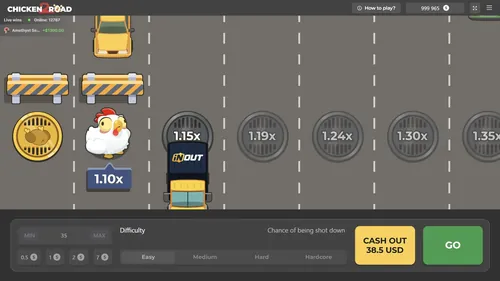
Setting a target multiplier
Chicken Road 2 features four distinct difficulty levels, each defining the maximum possible multiplier for a single successful round. Easy mode caps at x23.24 across thirty lanes, while Medium extends to x2,457 with twenty-five lanes. Hard mode pushes the limit to x62,162 using twenty-two lanes, offering significantly higher potential returns for aggressive strategies.
The most extreme option, Hardcore mode, utilizes only eighteen lanes but allows wins up to x3,608,855. Setting a target multiplier requires understanding these lane constraints, as fewer lanes increase the probability of an early crash. Players must balance their desired payout against the statistical likelihood of the chicken surviving the required number of steps in each tier.
Provably fair technology underpins these multipliers, ensuring that the outcome is generated transparently rather than through opaque algorithms. InOut Games allows users to verify the fairness of each round, adding a layer of trust to the targeting process. This verification confirms that the random seed determines the crash point independently of previous rounds or player actions.
Why automation removes hesitation
Hesitation often leads to missed exits when the multiplier climbs rapidly toward the end of a round in Chicken Road 2. Auto cashout eliminates this psychological barrier by executing the trade the instant the chosen threshold is met. This consistency prevents emotional decision-making, which typically results in holding onto bets too long until a crash occurs.
The medium volatility rating suggests that outcomes will fluctuate between small frequent wins and larger occasional payouts. Without automation, players might hesitate during volatile swings, potentially losing profits they could have secured earlier. The tool enforces discipline, ensuring that the theoretical return of 95.50% is approached more closely over thousands of rounds.
Contrast this with traditional slots, where spin delays allow time for second-guessing between reels stopping. Crash games like Chicken Road 2 operate in real-time, leaving no pause for reconsideration once the round begins. Automation bridges this gap, providing the speed necessary to capitalize on rapid multiplier increases without manual delay.
Low targets versus high targets
Low target multipliers, such as those near x2.00 in Easy mode, offer higher survival probabilities due to the thirty available lanes. These conservative settings align with the 95.50% RTP, aiming for steady accumulation rather than explosive growth. Players choosing this path accept smaller wins in exchange for reduced variance and more consistent bankroll preservation.
High targets in Hardcore mode require surviving eighteen lanes, drastically lowering the hit frequency for substantial payouts. While the max win reaches x3,608,855, the statistical chance of reaching these heights is minimal compared to lower tiers. This disparity forces players to decide between frequent small gains and rare, life-changing jackpot opportunities.
The difference between Easy and Hardcore modes illustrates the risk-reward spectrum inherent in InOut Games’ design philosophy. Easy mode provides up to x23.24 with ample safety nets, while Hardcore strips away security for maximum upside. Understanding this contrast helps players select the appropriate difficulty level for their specific risk tolerance and financial goals.
Auto bet alongside auto cashout
Auto bet functionality allows players to queue multiple wagers automatically, synchronizing them with the auto cashout triggers. This combination streamlines gameplay by removing the need to manually adjust stakes after each round in Chicken Road 2. Users can define a starting stake within the $0.01 to $200 range and let the system handle subsequent bets.
This dual automation supports structured betting systems, enabling consistent application of strategies like flat betting or progressive adjustments. By linking bet size to cashout targets, players maintain tighter control over their exposure during volatile periods. The system executes these predefined parameters without deviation, ensuring adherence to the chosen financial plan.
While Chicken Road offered similar features, Chicken Road 2 refines the interface for smoother integration of these tools. The 2025 release optimizes the user experience, making it easier to manage complex auto-betting sequences across different difficulty levels. This enhancement reduces friction, allowing players to focus on strategy rather than mechanical execution during intense sessions.
Chicken Road 2: key facts
| Parameter | Value |
|---|---|
| Game | Chicken Road 2 |
| Studio | InOut Games |
| Released | 2025 |
| RTP | 95.50% |
| House edge | 4.50% |
| Volatility | medium |
| Max win | x3,608,855 |
| Bet range | $0.01 – $200 |
Choosing a cashout target
The maximum win cap for Chicken Road 2 reaches x3,608,855 on the Hardcore difficulty setting, which provides eighteen distinct lanes for the rising multiplier. This upper limit stands in sharp contrast to Fish Road, where InOut Games restricts the top payout to x2,542,251.93 despite a slightly higher theoretical return rate of 96.00 percent. Selecting this extreme path requires accepting significant volatility because the probability of reaching such heights remains mathematically low compared to safer multipliers.
Easy mode offers thirty lanes and caps the potential return at x23.24, providing a much lower risk profile for mobile players who prefer shorter sessions. The house edge remains constant at 4.50 percent across all four difficulty tiers, meaning the theoretical return of 95.50 percent does not improve with simpler settings. Players targeting these smaller gains can expect more frequent successful cashouts, though the absolute profit per round is significantly diminished compared to high-risk strategies.
Medium difficulty balances the lane count at twenty-five while allowing multipliers to climb up to x2,457 before the chicken crosses the road. Hard mode reduces available lanes to twenty-two but increases the ceiling to x62,162, offering a middle ground between frequency and magnitude. Mobile users often switch between these modes based on bankroll size, as the bet range from $0.01 to $200 accommodates various staking levels effectively.
Frequency against payout size
The theoretical RTP of 95.50 percent applies over a very long run of rounds, establishing a house edge of 4.50 percent that never changes. This statistical average ensures that while short-term variance is high, the game returns roughly ninety-five cents for every dollar wagered over time. Such consistency allows analysts to predict long-term losses accurately, regardless of whether the player chooses the easy thirty-lane path or the hardcore eighteen-lane variant.
Fish Road by InOut Games achieves a higher RTP of 96.00 percent, yet its maximum win is capped at x2,542,251.93, which is lower than the three-point-six million potential here. This comparison highlights how Chicken Road 2 sacrifices slight mathematical efficiency for greater upside potential through its harder difficulty settings. The medium volatility rating suggests that wins will occur regularly enough to sustain play without exhausting the balance too quickly.
Auto cashout features allow players to set specific multiplier targets, removing reaction time from the outcome while preserving the built-in house edge. Setting an automatic exit at x2.00 on Easy mode generates frequent small wins, whereas targeting x1000 on Hardcore yields rare large payouts. Understanding this trade-off helps mobile gamers align their betting strategy with their personal risk tolerance and desired session length effectively.
Testing targets in demo
Players can practice using the demo version to explore the four difficulty levels without risking real funds from their initial deposit. The provably fair system ensures that every round result is verifiable, giving users confidence in the integrity of the mechanics during testing phases. This transparency is crucial for understanding how the eighteen lanes on Hardcore mode behave differently from the thirty lanes available on the easiest setting.
The bet range spans from $0.01 to $200, allowing users to test various stake sizes safely within the free play environment. Small bets help visualize the frequency of crashes on Medium difficulty, while larger wagers demonstrate the impact of volatility on the overall balance. Observing these patterns helps players determine which difficulty level suits their preferred pace of play before committing any actual money.
InOut Games designed this sequel to offer clear visual feedback for each step of the rising multiplier, aiding decision-making during live sessions. The auto mode feature becomes particularly useful once a player identifies a consistent target multiplier that fits their bankroll management strategy. Testing different cashout points in demo reveals how often the chicken survives versus how frequently it gets hit on each specific lane configuration.
Adjusting after a losing streak
A sequence of failed cashouts does not alter the underlying 95.50 percent RTP or the fixed 4.50 percent house edge inherent in the game logic. Each round operates independently, meaning previous losses have no mathematical influence on the probability of the next multiplier rising successfully. Recognizing this independence prevents players from falling into the gambler's fallacy when deciding whether to increase their bet size after a downturn.
Switching from Hardcore mode back to Easy mode reduces the maximum possible win from x3,608,855 down to just x23.24, but significantly increases survival rates. This tactical shift lowers the volatility exposure, allowing the bankroll to recover gradually through more frequent, albeit smaller, successful exits. The thirty lanes on Easy provide a buffer against rapid depletion compared to the tight eighteen lanes found on the hardest difficulty tier.
Fish Road offers a comparable alternative with its x2,542,251.93 max win and 96.00 percent RTP, providing a different risk-reward profile for those seeking variety. While Chicken Road 2 focuses on lane-based progression, other titles might offer different mechanics that appeal to players recovering from losses. Sticking to one difficulty level consistently helps maintain discipline, whereas constantly switching modes can lead to uncontrolled spending habits.
The welcome bonus of 300 percent up to €2,000 plus 100 free spins provides additional funds to absorb variance during challenging sessions. Using these bonus credits allows players to test higher stakes on Medium difficulty without touching their own deposited capital. This financial buffer extends playtime and provides more data points for analyzing performance across different multiplier targets effectively.
When to turn automation off
Auto cashout removes human reaction time from the equation, ensuring a bet closes automatically at a chosen multiplier without emotional interference. However, relying solely on automation can prevent players from adapting to sudden shifts in luck or recognizing optimal moments to adjust stakes manually. Turning off auto mode restores direct control, allowing for immediate responses to the rising multiplier curve on any of the four difficulty settings.
On Hardcore mode, the eighteen lanes present a steep challenge where manual intervention might help avoid cashing out too early on promising runs. The potential for x3,608,855 requires patience that automated systems cannot always replicate if the preset target is too conservative. Players may choose to disable automation temporarily to chase higher multipliers, accepting the increased risk of losing the entire stake in that round.
Comparing this approach to Fish Road, where the max win is x2,542,251.93, shows that different games demand different levels of active management. Chicken Road 2's lane structure makes manual timing particularly relevant, as the visual cues of the chicken crossing are immediate triggers for action. Disabling automation fosters greater engagement with the game mechanics, enhancing the overall experience for dedicated mobile gamers.
Double bet setups
InOut Games released Chicken Road 2 in 2025, offering a maximum win of x3,608,855 across its four difficulty tiers. This potential payout applies to the Hardcore mode with eighteen lanes, where players must cash out before the chicken is hit to secure the top prize. Mobile users benefit from this structure because they can allocate separate stakes to different risk levels simultaneously on their devices.
The betting range spans from $0.01 to $200 per round, allowing for flexible bankroll management when splitting wagers between Easy and Medium modes. A player might place a small $0.01 bet on the Easy level with thirty lanes to cover costs while aiming for larger returns elsewhere. This strategy leverages the medium volatility to balance frequent small wins against the rare but massive payouts available in harder settings.
Rabbit Road by InOut Games shares the identical RTP of 95.50% and max win cap of x3,608,855, yet differs in lane configuration compared to Chicken Road 2. Comparing these titles reveals that doubling down on bets does not alter the theoretical return, which remains fixed at 95.50% over long runs. Mobile interfaces facilitate quick transitions between these similar crash games without requiring reloads or additional downloads for seamless comparison.
Splitting stakes across two bets
Chicken Road 2 features four distinct difficulty levels, including Easy with thirty lanes up to x23.24 and Medium with twenty-five lanes up to x2,457. Players often split their total stake between these two modes to hedge against the higher variance found in Hard and Hardcore variants. The provably fair system ensures that each split bet operates independently, maintaining transparency regardless of how many concurrent rounds are active on mobile screens.
The house edge stands at 4.50%, calculated as one minus the 95.50% RTP, meaning every dollar wagered carries this specific statistical disadvantage. By dividing a $10 stake into two $5 bets on Easy and Medium modes, a user reduces exposure to the extreme multipliers of the Hardcore tier. This approach stabilizes losses during streaks while still participating in the game mechanics that define the crash genre's appeal for instant gratification.
In comparison, Rabbit Road offers the same 95.50% RTP but lacks the specific lane counts of Chicken Road 2, such as the eighteen lanes in Hardcore mode. Mobile players can monitor both games side-by-side to optimize their split strategies based on real-time multiplier growth rates. Understanding that the auto cashout feature removes reaction time helps users set precise limits for each half of their divided stake effectively.
Combining a safe and a risky target
A common mobile strategy involves pairing a conservative cashout target in Easy mode with an aggressive one in Hardcore mode, leveraging the x3,608,855 max win potential. The Easy level provides thirty lanes and caps at x23.24, offering a safer baseline return that helps recover initial losses from riskier bets. This combination exploits the medium volatility by ensuring some positive equity even when the high-risk portion of the portfolio encounters a crash.
The betting limit of $200 allows substantial capital allocation to the risky target, provided the safe bet uses a fraction like $0.01 to minimize drag. Since the game has no reels or spins, success depends entirely on timing the cashout before the chicken is hit, making split targets crucial for risk management. Players must remember that the 4.50% house edge applies uniformly, so the expected value of the combined strategy remains negative over infinite trials.
Unlike slots, Chicken Road 2 relies on a rising multiplier rather than spinning symbols, requiring distinct tactical decisions for each bet type. Mobile users can utilize the auto mode to lock in gains for the safe bet while manually controlling the risky one for maximum flexibility. This hybrid approach mirrors techniques seen in Rabbit Road, though the latter lacks the specific lane diversity that defines Chicken Road 2's unique risk profile.
Limits of any automated plan
The auto cashout function closes a bet automatically at a chosen multiplier, removing human reaction time from the outcome calculation entirely. While convenient for managing multiple simultaneous bets on a small screen, it does not change the built-in 4.50% house edge inherent to the 95.50% RTP. Players relying solely on automation may miss opportunities to adjust stakes dynamically in response to the rapid multiplier increases characteristic of the Hardcore difficulty level.
InOut Games designed Chicken Road 2 with provably fair mechanics, ensuring that outcomes are verifiable regardless of whether manual or automatic methods are used. However, the maximum win of x3,608,855 is capped, meaning no automated sequence can generate unlimited profits even if the algorithm predicts crashes perfectly. Mobile players should recognize that setting an auto cashout at x1000 does not guarantee safety, as the chicken can be hit at any lower multiplier due to randomness.
Comparing this to Rabbit Road, which also offers an RTP of 95.50%, highlights that automation limits are universal across similar crash games from the same studio. The inability to influence the underlying RNG means that complex automated plans cannot overcome the mathematical reality of the 4.50% house edge. Users must accept that technology streamlines execution but cannot alter the fundamental probability distribution governing each individual round of play.
What automation cannot fix
Automation cannot eliminate the 4.50% house edge, which persists regardless of how sophisticated the cashout algorithm becomes within Chicken Road 2. The theoretical return of 95.50% dictates that long-term profitability is statistically impossible, even when utilizing the full betting range from $0.01 to $200. Mobile players must understand that speed advantages offered by auto-mode do not translate to positive expected value over thousands of consecutive rounds played.
The game's medium volatility implies that streaks of losses can deplete balances faster than anticipated, a risk that automated systems cannot mitigate without altering the base parameters. Unlike slot machines with bonus rounds, Chicken Road 2 offers only the core mechanic of crossing lanes, limiting strategic depth beyond simple bet sizing. The absence of secondary features means that no amount of programming sophistication can create value where none exists mathematically within the defined ruleset.
Even when comparing Chicken Road 2 to Rabbit Road, both sharing the same 95.50% RTP and x3,608,855 max win cap, the limitations of automation remain identical. Players cannot use software to predict when the chicken will be hit, as the provably fair system ensures true randomness in each round. Consequently, reliance on automated plans often leads to faster bankroll erosion rather than sustained growth, highlighting the importance of manual discipline in crash gaming.
DemoRTP & VolatilityHow to PlayAuto CashoutStrategyBonusesMobileDownload & AppMax WinSimilar GamesReviewFAQSitemap
Chicken road 2 2026